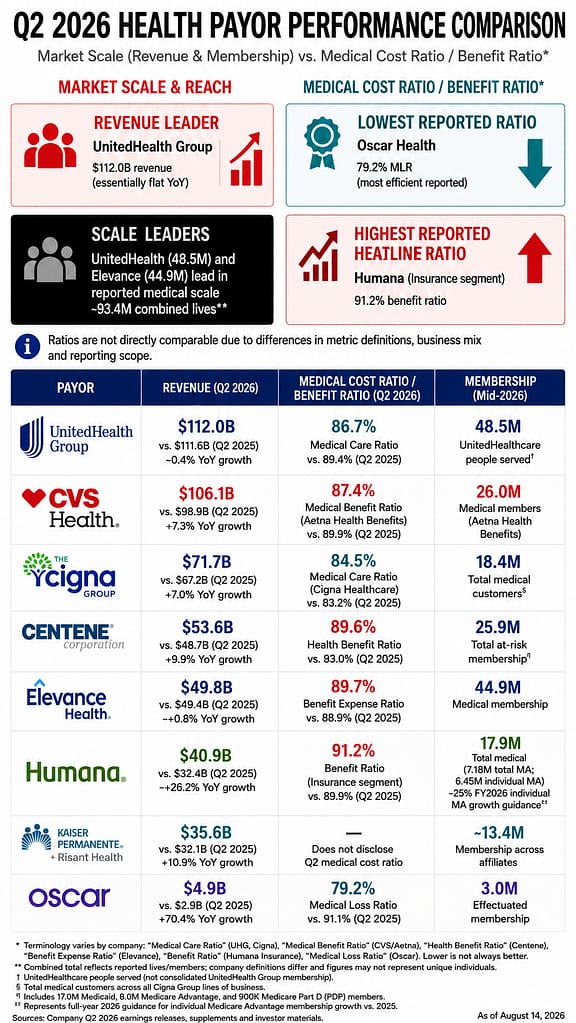

Q2 2026 payor earnings showed it was a pretty good quarter for the country’s largest health insurers. Financial performance generally improved, several companies increased their full-year outlooks, and some of the medical-cost pressure that dominated managed-care results over the past year showed signs of becoming more manageable.
The more interesting story was happening in membership.
For years, membership growth was one of the simplest ways to tell the managed-care growth story. More members brought more premium revenue, greater scale, and more negotiating leverage. As payors expanded into pharmacy, physician practices, home health, and specialty care, adding covered lives created opportunities to generate value elsewhere in the enterprise. The Q2 numbers suggest payors are getting much more particular about where they want that growth.
UnitedHealthcare, Centene and Elevance all reported meaningful membership declines across portions of their businesses. CVS’s medical membership was below the prior year, and Cigna is preparing to leave the Individual and Family Plans medical business in 2027. The reasons vary, including Medicaid eligibility changes, customer transitions and deliberate product and market decisions.
Centene offers a good example of what selectivity can do to the underlying economics. Medicaid and Commercial membership both declined, while pricing, rates, risk adjustment, and membership mix changed the economics of the remaining business. Medicare moved differently, with growth concentrated primarily in Part D.
Payors can pursue growth where they like the pricing and risk, reduce exposure where they don’t, and consider what a member may be worth across other parts of the enterprise.
Oscar and Humana make the quarter particularly interesting because both are pursuing significant membership growth in markets where other national payors have become more cautious.
Growth needs a thesis
Oscar has made the individual market central to its strategy while several national insurers have reduced their exposure to the ACA Marketplace.
CEO Mark Bertolini believes a more fluid labor market will increase demand for individual insurance as people move among full-time employment, part-time work, gig work, and retirement. He expects AI to accelerate those shifts, and Oscar believes its pricing, consumer products and technology platform give it an advantage serving those members. Membership reached nearly 3 million in Q2, roughly 46% higher than a year earlier.
It’s a fascinating bet because Oscar’s competitors can see the same market. Several have decided to reduce their exposure anyway.
Investors have doubts too. Oscar’s stock fell about 12% following its Q2 results despite strong earnings and an improved outlook, with concerns about future ACA enrollment contributing to the reaction. The market reaction doesn’t tell us whether Bertolini is right, but it shows just how far Oscar’s outlook diverges from the prevailing caution around the Marketplace.
For hospitals and health systems, the outcome matters. If consumers move more frequently between employer-sponsored insurance and individual coverage, Marketplace contracts become more important to the health system’s overall commercial strategy. The patient may change insurance products without changing physicians, hospitals, or healthcare needs.
That should affect contract negotiations. A payor trying to grow Marketplace membership needs a network consumers will buy. If competing health systems have left an ACA network, a remaining provider’s geography, specialty coverage, brand recognition, and physician relationships can become more valuable to the product. Vertically integrated payors with their own physicians and ambulatory assets may have more alternatives.
Health systems should know how aggressively the payor wants to grow the product, where its members are concentrated, which services require the system’s participation and how credible the payor’s alternatives really are.
Humana is pursuing growth for a different reason. The company continues to expect significant individual Medicare Advantage growth even though newer MA members tend to carry higher benefit ratios. Humana believes those economics can improve over time through retention, quality performance, risk adjustment, care management, and lower avoidable utilization.
CenterWell gives Humana more ways to influence that trajectory through primary care, pharmacy, and home-based services. For providers, that means understanding how Humana’s long-term Medicare Advantage strategy intersects with their own capabilities. A health system with strong primary care, clinically integrated networks or demonstrated performance managing Medicare populations may have capabilities Humana needs. A system competing with CenterWell for primary care and ambulatory volume occupies a very different position.
Oscar and Humana are pursuing growth because they believe they have a specific way to make those members economically attractive. That is increasingly what growth in managed care seems to require.
The value of a member increasingly extends across the enterprise
Vertical integration adds another layer to the membership equation.
An Aetna member can interact with Caremark and CVS Pharmacy. A Humana MA member may receive care through CenterWell. Cigna can connect health plan and PBM relationships with specialty pharmacy and clinical services. UnitedHealthcare operates alongside Optum’s care-delivery, pharmacy, and healthcare-services businesses.
Our Q1 2026 payor earnings analysis raised questions about whether these vertically integrated models were actually producing the promised economic benefits. Q2 gave us a few interesting signals.
At Cigna, Pharmacy Benefit Services revenue increased while adjusted operating income declined 27%, but Specialty and Care Services increased adjusted operating income 22%. The PBM gives Cigna relationships and scale that can feed businesses focused on specialty medications and complex patients.
Kaiser Permanente provides the more mature version of integration. Its Q2 operating margin improved to 4.6%, with management pointing to operating efficiency and scale. Risant Health is now testing whether some of Kaiser’s value-based capabilities can work inside established health systems that developed under very different models.
These strategies matter to providers because owned care-delivery assets give payors more options for where members receive care and where the economics of that care accrue. Health systems need to understand where they complement those assets, where they compete with them and where the payor still depends on their network.
Payors are also getting more sophisticated about managing the medical costs of the members they choose. UnitedHealth pointed to medical cost management, pricing discipline, and benefit design. Elevance is investing in medical cost management and provider connectivity. CVS is deploying AI in provider and member interactions and has introduced an AI-powered claims tool designed to accelerate complex claims processing.
Those investments can reduce real friction through faster claims, better data exchange, and more efficient prior authorization. They can also give payors more capacity to apply utilization-management rules, review claims and administer care without adding staff.
We raised that issue in our Q1 payor earnings analysis, and it remains important for providers. The contractual implications include prior-authorization requirements, denial and appeal standards, payment timelines, data exchange, escalation processes, and the administrative obligations assigned to each party.
As payors become more selective about the populations they cover, the tools they use to manage those populations deserve just as much attention.
Know your position in market
For providers, the Q2 membership trends add another layer to contract preparation. Health systems should understand where the payor wants to grow, where it is willing to lose members, what care-delivery assets it already owns and where it still depends on the provider network.
Those answers can reveal leverage that reimbursement benchmarks won’t. A payor pursuing Marketplace growth may need a health system’s brand, geography, or specialty coverage. A Medicare Advantage plan focused on total cost of care may place greater value on proven clinical performance, while a vertically integrated payor may have credible alternatives for services it can steer toward owned assets.
That context should shape negotiations around reimbursement, network participation, utilization management, and administrative requirements.
Q2 suggests payors are becoming more deliberate about the members, products, and markets they pursue. Providers should bring the same discipline to understanding what the payor needs from them before the next contract negotiation begins.